
You’ve seen it in a TikTok comment section. You’ve heard a friend mutter it under their breath when someone gives the same boring answer for the third time. You’ve maybe even seen it plastered across a gym bag or a competition banner. Three letters, four completely different worlds: NPC.
Depending on who’s saying it and where, NPC can mean a background character in a video game, a savage insult about someone’s personality, a wildly popular dating trend, a prestigious amateur bodybuilding title, or the name of one of the largest legislative bodies on Earth. This guide walks through every major meaning of NPC, where it started, how it spread, and how to actually use it (or avoid it) depending on the context you’re in.
Where NPC Comes From: Gaming Roots
Every meme has an origin story, and NPC’s begins on a screen, not a smartphone.
The Basic Definition
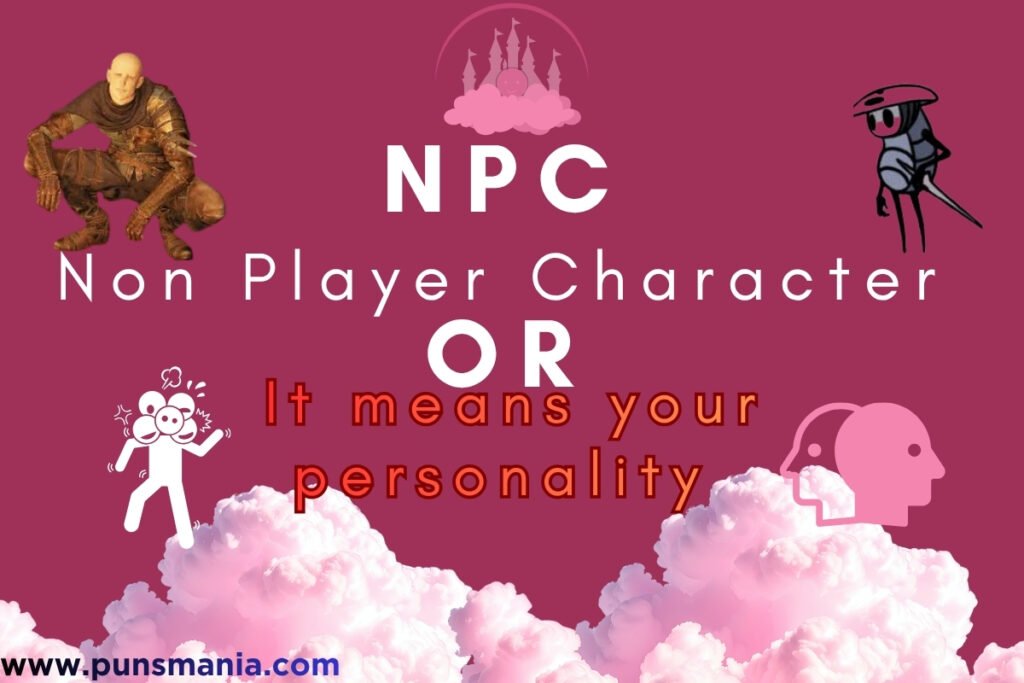
NPC stands for Non-Player Character (occasionally written as Non-Playable Character). It refers to any character in a video game that isn’t controlled by a human being sitting at the keyboard or controller. Instead, NPCs run on pre-written scripts, simple AI behavior trees, or fixed dialogue trees built by the game’s developers.
If you’ve ever played a game, you’ve talked to hundreds of them without a second thought.
The Many Flavors of NPC
Not all NPCs are created equal. Game designers generally sort them into a few overlapping categories:
- Combat and guard NPCs — characters built to patrol territory, spot threats, fight enemies, or even join the player as a hired companion.
- Wildlife and creature NPCs — non-human characters like animals or monsters, ranging from passive prey that flee on sight to aggressive predators that hunt the player down.
- Functional NPCs — the shopkeeper who sells you potions, the blacksmith who upgrades your armor, the innkeeper who lets you rest. They exist to serve a gameplay purpose rather than tell a story.
- Story NPCs — quest-givers, mentors, rivals, and side characters who move the plot forward, often marked with a floating icon over their heads.
NPCs You Already Know
A few examples make the concept click instantly:
- The wandering villagers of Hyrule in The Legend of Zelda series, who hand out hints, side quests, and the occasional bizarre one-liner.
- The Skyrim city guards, whose complaints about old adventuring injuries became so widely repeated online that the line itself turned into a meme.
- The pedestrians and drivers filling the streets of Los Santos in Grand Theft Auto V, giving the city the feeling of being genuinely alive.
Across every genre and every region of game development — from Japanese RPGs to Western open-world titles to mobile games made in South Korea and Southeast Asia — NPCs serve the same basic role: they make a digital world feel populated without requiring another human player.
How NPC Escaped the Game and Became an Insult
Slang doesn’t usually travel in a straight line, and NPC’s journey from code to culture is a good example of that.
The Meaning Shift
Sometime in the late 2010s, internet communities started using “NPC” to describe real people — specifically, people perceived as unoriginal, predictable, or incapable of independent thought. Calling someone an NPC implies they’re running on autopilot, mindlessly repeating whatever opinion or phrase is currently circulating, the same way a background character in a game recycles the same three lines of dialogue no matter what you do.
The Wojak Connection
The insult exploded thanks to a specific image: the NPC Wojak, a flat, gray, expressionless face derived from the older “Wojak” meme format. The blank, lifeless design was deliberate — it was built to represent a person with no distinguishing traits, no strong opinions of their own, and no visible inner life.

The meme was initially aimed at political and social media discourse, mocking users who seemed to parrot identical talking points in identical language, as if they were all reading from the same script. It’s worth noting that this framing has always cut both ways — it’s been used across the political spectrum to dismiss opponents as unthinking, which is part of why the term can land as genuinely mean-spirited rather than just playful, depending on who’s using it and why.
NPC in Everyday Texting
Outside of politics, NPC settled into a much lighter, more casual role on WhatsApp, Instagram, and TikTok. It’s become one of those all-purpose slang terms people reach for constantly — often self-deprecating, often just teasing a friend.
A few ways people actually use it in chats:
- Calling out predictability: “He just repeats everything his friends say — total NPC.”
- Joking about your own low-energy day: “I’m running on autopilot today, full NPC energy.”
- Poking fun at conformity: “Everyone in the same outfit at the festival? NPC behavior.”
- Reacting to a bland, generic reply: “Bro just said ‘cool’ again — NPC response.”
Used this way, it’s rarely meant as a serious insult. It’s closer to calling someone basic or extra — exaggerated slang for comedic effect, deployed by people across every background and age group who grew up around gaming culture, whether or not they’ve ever actually played the games the term came from.
NPC Dating: When Gen Z Turned an Insult Into a Trend
Just when NPC seemed locked in as a put-down, Gen Z did something unexpected with it: they turned it into a bit.
The #NPCDate trend on TikTok — which has racked up tens of millions of views — flips the insult into deliberate performance art. Instead of avoiding NPC behavior, participants lean all the way into it, treating an actual first date like a video game cutscene.
Common bits from the trend include:
- Dressing like a Sims character, sometimes complete with a green “Plumbob” headband floating above the head.
- Speaking in flat, scripted-sounding dialogue, like greeting a date with something along the lines of “You are looking quite optimal today, traveler.”
- Performing exaggerated, robotic movements — fake screen “lag,” frozen T-poses, or repetitive finger-gun gestures, mimicking the canned animation loops of low-budget game characters.
It’s ironic, it’s silly, and it works as an icebreaker precisely because everyone involved knows it’s a joke. The trend has been embraced by daters of every gender and orientation, and it says something about how thoroughly gaming language has folded into mainstream youth culture — a term that started as a criticism of humans became a costume people happily put on for laughs.
NPC in Bodybuilding: A Completely Different Kind of Prestige
Switch industries entirely, and NPC stops being an insult and starts being an honor.
The National Physique Committee
In competitive bodybuilding and physique sports, NPC stands for the National Physique Committee. Founded in 1982 by Jim Manion, it’s the largest amateur bodybuilding organization in the United States, and it functions as the primary launchpad for athletes hoping to eventually compete at the professional level.

Why the NPC Matters
The NPC holds a specific kind of authority: it’s the only amateur organization officially recognized by the IFBB (International Federation of BodyBuilding and Fitness) Professional League, the governing body behind the sport’s biggest professional stage, including the legendary Mr. Olympia contest.
For amateur athletes — men and women, across bodybuilding, physique, bikini, classic physique, and fitness divisions — earning an NPC card and placing well at NPC events is often the single most direct path toward a professional career. It represents years of discipline, not a criticism of anyone’s personality.
NPC in Government and Politics
Zoom out again, and NPC takes on a third, entirely unrelated meaning: an official state institution.
The National People’s Congress
In China, NPC is the standard abbreviation for the National People’s Congress, the country’s national legislature. It is, by sheer size, the largest parliamentary body in the world, with delegate numbers in the thousands representing provinces, autonomous regions, and municipalities across the country. Understanding this meaning matters for anyone reading international news, since headlines referencing “the NPC” in a policy or governance context are almost always talking about this body, not a video game term.

Other, Less Common Government Uses
A handful of smaller or more regional uses of the acronym also exist, including:
- National Patriotic Commission — used in some countries for committees focused on civic or national loyalty programs.
- Non-Partisan Committee — a body explicitly organized to stay independent of any political party.
- Neighborhood Planning Committee — a local council focused on community and urban development decisions.
As always with acronyms, context does all the heavy lifting. The same three letters can refer to a global legislature or a local zoning meeting depending entirely on where you encounter them.
Quick Reference: NPC Meanings by Context
| Context | Meaning | Example | Notes |
|---|---|---|---|
| Gaming | Non-Player Character | Shopkeeper in Skyrim | AI-driven, not human-controlled |
| Internet slang | Someone seen as unoriginal or predictable | “Total NPC energy” | Can be playful or genuinely critical |
| Dating (TikTok) | A trend imitating game-character behavior | The #NPCDate trend | Ironic, performative, widely embraced by Gen Z |
| Bodybuilding | National Physique Committee | “She earned her NPC card” | The main U.S. amateur bodybuilding organization |
| Politics (China) | National People’s Congress | “The NPC passed new legislation” | The world’s largest legislative body |
What’s the Opposite of an NPC?
If an NPC is defined by a lack of agency, the natural opposite is the “Main Character.”
Borrowed from the exact same video-game logic, having “Main Character Energy” means living like you’re the protagonist of your own story — making deliberate choices, standing out, and driving your own plot instead of reciting someone else’s lines. It’s become its own huge slang trend in parallel with NPC, and the two terms are often used together as a kind of spectrum: are you the one making decisions, or just filling out the background?
Frequently Asked Questions
What does NPC stand for in gaming?
NPC stands for Non-Player Character — any character in a game that’s controlled by the game’s AI or scripting rather than by a human player.
Is calling someone an NPC offensive?
It can be. In political or social contexts, it’s often meant as a genuine insult implying someone can’t think for themselves. In casual texting between friends, it’s usually lighthearted teasing rather than a serious attack.
How does NPC relate to bodybuilding competitions?
NPC is the National Physique Committee, the largest amateur bodybuilding organization in the U.S. Athletes compete at NPC events to build toward earning professional status with the IFBB Pro League.
What does NPC mean in Chinese politics?
It refers to the National People’s Congress, China’s national legislature and the largest parliamentary body in the world.
Can NPC ever be a compliment?
Not really as slang — but in gaming, NPCs aren’t an insult at all. They’re essential to storytelling, world-building, and immersion. Without them, most games would feel empty.
Where did the NPC dating trend come from?
It grew out of TikTok, where users started turning the “predictable, scripted” stereotype of an NPC into a deliberate, ironic bit for first dates — repetitive dialogue, robotic movements, and video-game-inspired outfits included.
Conclusion
Few acronyms stretch this far. NPC can describe a friendly shopkeeper, a scathing political jab, a viral dating stunt, a hard-earned athletic title, or one of the most powerful legislative bodies on the planet, and the only thing separating those meanings is context. So next time someone gets called an NPC, don’t assume you know what they mean. Ask yourself: are we talking about gaming, politics, dating, fitness, or government? Once you know the room you’re in, the meaning is obvious.
And if you ever catch yourself giving the same three answers to every conversation this week, well, maybe it’s time to log off autopilot and go be the main character for a bit.